
Celebrating Ingenuity: An Ode to the Mars Helicopter on Its Anniversary
The Mars Helicopter, affectionately named Ingenuity, stands as a beacon of human creativity and innovation, highlighting our relentless pursuit of knowledge beyond Earth. Its development marks a significant milestone in aerospace engineering, showcasing the potential of engineering teams tasked with turning a vision into reality.
THIS MONTH
Rupa Soni
4/19/20258 min read
The Historic First Flight: A Milestone in Aviation
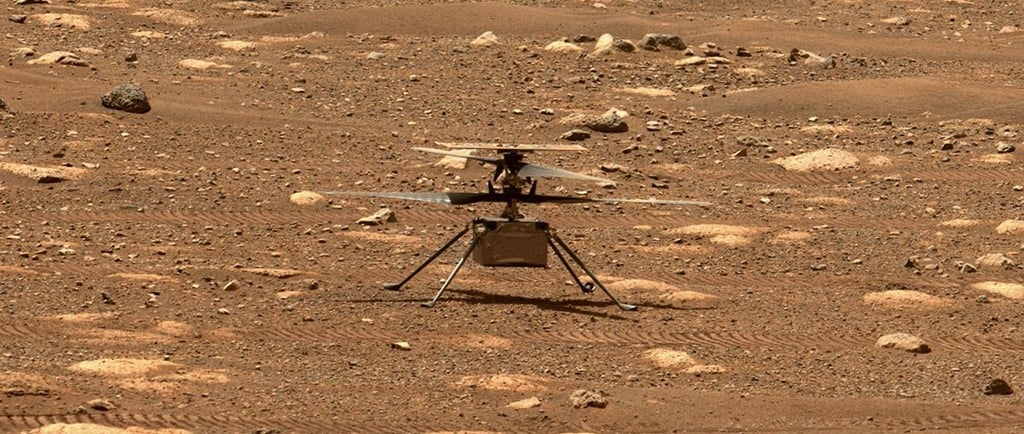
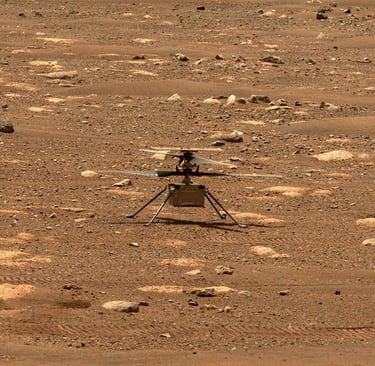
On April 19, 2021, the Mars Helicopter, known as Ingenuity, marked a pivotal moment in the annals of aviation history by successfully achieving its first flight on another planet. This accomplishment not only underscored the potential for powered flight in extraterrestrial environments but also resonated deeply with the legacy of human ingenuity that traces back to the Wright Brothers' maiden flight in 1903. The successful test flight of Ingenuity is significant as it symbolizes a direct evolution in the quest for innovation in aerospace engineering.
Ingenuity's flight lasted for approximately 40 seconds, ascending to an altitude of about 10 feet before hovering and landing safely on Martian soil. This maneuver was groundbreaking, as it was the first instance of an aircraft performing powered, controlled flight on a planet other than Earth. Such an achievement required overcoming substantial challenges related to the thin Martian atmosphere, which is less than 1% as dense as that of Earth. Engineers and scientists leveraged advanced aerospace technology to design and build a helicopter capable of functioning under these unique conditions.
Central to this accomplishment was the lightweight design and innovative rotor system used in Ingenuity. The rotor blades, spanning over four feet in diameter, revolved at approximately 2,400 revolutions per minute, significantly higher than Earth-bound helicopters. This engineering feat mirrors the initial experimentation phase of powered flight, emphasizing how far humanity has advanced in the field of aeronautics. These innovations not only extend our capabilities in exploring distant worlds but also pave the path for future aerial exploration missions, potentially leading to advancements that will further elevate our understanding of other planetary atmospheres.
A Symbol of Human Ingenuity and Innovation
The Mars Helicopter, affectionately named Ingenuity, stands as a beacon of human creativity and innovation, highlighting our relentless pursuit of knowledge beyond Earth. Its development marks a significant milestone in aerospace engineering, showcasing the potential of engineering teams tasked with turning a vision into reality. The story of Ingenuity is not merely that of a machine, but rather a testament to the dedication and hard work of countless individuals who contributed to its creation. The collaborative efforts of engineers, scientists, and technicians exemplify the essence of teamwork and ingenuity.
As the first powered aircraft to fly on another planet, Ingenuity redefines the limits of what is possible in aerospace exploration. The technology behind its design and operation demonstrates a remarkable synergy of creativity and technical problem-solving. Engineers faced numerous challenges, from how to generate lift in the thin Martian atmosphere to ensuring the helicopter could survive the extreme temperatures of the Martian night. Each challenge required innovative solutions, as teams experimented with weight reduction, rotor dynamics, and autonomous navigation. Ingenuity embodies the spirit of innovation by successfully overcoming these hurdles through a combination of theoretical knowledge and practical application.
Moreover, the success of Ingenuity encourages future endeavors in planetary exploration. It inspires the next generation of scientists and engineers to dream bigger and push beyond existing boundaries in science and technology. The helicopter has not only provided invaluable data on Mars’ atmosphere and terrain but has also paved the way for future aerial exploration of other celestial bodies. In essence, Ingenuity serves as a symbol of how human ingenuity can foster groundbreaking advancements, exemplifying the technological evolution we are capable of achieving when creativity is paired with perseverance and dedication.
Overcoming Challenges: The Journey to Mars
The journey of NASA's Ingenuity helicopter to Mars is a testament to the resilience and determination inherent in aerospace engineering. From the initial design phase, the development team faced several engineering hurdles that required innovative solutions and adaptability. One of the most significant challenges was designing a rotorcraft capable of functioning in the thin Martian atmosphere, which has only about 1% of the density of Earth’s atmosphere. To address this, engineers opted for larger, lighter blades to generate enough lift, a decision that necessitated extensive wind tunnel testing to validate performance under Martian conditions.
Another challenge involved ensuring the helicopter’s systems could withstand extreme temperatures and varied environmental conditions. Mars experiences severe temperature fluctuations that can drop to minus 80 degrees Fahrenheit at night. The team meticulously selected materials and designed components to ensure reliability. Utilizing cutting-edge technologies, such as a rechargeable battery, allowed the helicopter to operate efficiently despite the harsh climate. These considerations reflect the broader challenges of planetary exploration, where engineers must anticipate and mitigate a range of potential failures.
The challenges extended beyond mere engineering as they also encompassed the integration of technology. The Ingenuity mission required seamless collaboration between various teams, each specializing in distinct fields. Ensuring synchronization among the aerospace engineers, software developers, and mission planners demanded exceptional teamwork and communication. The deployment phase posed its unique set of tests, as the helicopter needed to be unleashed from the Perseverance rover and execute its flights autonomously due to communication delays with Earth.
Ultimately, each obstacle encountered on the path to the skies of Mars was an opportunity for learning and innovation. Ingenuity's successful flights have not only marked a monumental milestone in exploration but have also inspired future missions, proving that determination can overcome even the most daunting challenges in aerospace engineering.
The Impact of Ingenuity on Space Exploration
The Mars Helicopter, known as Ingenuity, has significantly transformed our approach to space exploration and has set a new precedent for future missions beyond our planetary sphere. As the first powered vehicle to achieve controlled flight on another planet, Ingenuity represents a monumental leap in aerial technology, enhancing our capabilities to explore extraterrestrial environments. Through its successful flights, it has provided invaluable data about the Martian atmosphere and surface, thereby deepening our understanding of the challenges associated with aerial operations in hostile conditions.
One of the most profound impacts of Ingenuity lies in its demonstration of how aerial vehicles can complement surface rovers in exploring planetary terrains. Traditionally, most robotic missions have relied heavily on rovers to navigate and collect data from the ground. However, Ingenuity’s flights pave the way for a paradigm shift in how scientists and engineers envision future missions. The helicopter can scout inaccessible regions, identify potential landing sites, and relay critical information back to the rovers or orbiters, thereby enhancing mission efficacy.
Furthermore, the success of Ingenuity encourages the development of similar aerial technologies that can be applied to upcoming exploration endeavors, not only on Mars but also on other planetary bodies like Titan or the icy moons of Jupiter and Saturn. These future missions could utilize aerial drones for various tasks, from surveying landscapes to conducting atmospheric analyses, thus broadening the scope of exploration and research significantly. Ingenuity’s achievements indicate that aerial exploration will become a fundamental aspect of planetary missions, opening avenues for discovering new scientific phenomena and expanding our reach in the solar system.
Celebrating the Legacy of Ingenuity
As we celebrate the anniversary of the Mars Helicopter, Ingenuity, it is essential to recognize its significance beyond mere engineering. Ingenuity represents a remarkable achievement in human ingenuity, serving as a testament to the relentless pursuit of knowledge and exploration. This achievement is a legacy of perseverance, highlighting what is possible when ambition meets innovation. The remarkable success of Ingenuity not only reshapes our understanding of aerial mobility on other planets but also underscores the importance of celebrating such milestones in our history.
Every successful mission inspires future generations by demonstrating what can be achieved through dedication and creativity. Ingenuity has set a standard for future aerospace projects, marking a pivotal moment in space exploration. This helicopter, which successfully completed its inaugural flight on Mars, symbolizes the potential that lies within science and technology. By commemorating this achievement, we instill a sense of pride and encouragement in aspiring scientists, engineers, and explorers around the globe.
Moreover, the celebration of Ingenuity encourages a culture of innovation, reminding us that setbacks can lead to groundbreaking advancements. Reflecting on the challenges faced throughout its development and subsequent flights reveals the trials of failure, experimentation, and eventually, triumph. This narrative motivates individuals to adopt a mindset of resilience, emphasizing that each success is built upon the lessons learned from previous attempts.
In recognizing the legacy of Ingenuity, we foster a community that values exploration and scientific inquiry. Such acknowledgement fuels further innovation, inspiring a new generation to dream big and pursue careers in fields that contribute to humanity's understanding of our universe. By celebrating these achievements, we nurture a continuing cycle of inspiration, creativity, and exploration that propels humanity forward.
What the Future Holds: The Next Frontier in Aviation
The successful deployment and operation of the Mars Helicopter, Ingenuity, marks a monumental achievement in aviation technology and paves the way for future advancements that extend beyond interplanetary exploration. As aerospace engineers analyze the methodology and data generated by Ingenuity’s flights, it becomes evident that the principles behind its design and functionality will inspire innovations in various sectors of aviation on Earth.
One of the most significant implications of Ingenuity's success is the potential to enhance unmanned aerial vehicles (UAVs), commonly known as drones. The adaptability of Ingenuity to navigate the thin Martian atmosphere showcases new aerodynamic principles that, when refined, could improve drone efficiency and maneuverability. As a result, we may witness the emergence of drones capable of performing complex tasks in diverse environmental conditions, including urban landscapes, disaster relief situations, and agricultural monitoring.
Furthermore, the miniaturization of technology demonstrated by Ingenuity emphasizes how compact systems can achieve high-performance standards. This trend can lead to the development of smaller, more efficient aircraft and multifunctional UAVs that integrate artificial intelligence for real-time decision-making, significantly advancing automation in aviation. As these technologies develop, we could see innovations such as autonomous air taxis and enhanced cargo transport systems that rely on advanced drone technology.
Moreover, the lessons learned from Mars exploration could inspire new materials and propulsion systems. Innovations in lightweight composites and energy-efficient technologies are likely to emerge from research focused on enhancing the performance of helicopters and other aerial vehicles in extreme environments. This research could ultimately influence commercial aviation, improving fuel efficiency and reducing environmental impact.
As we look to the horizon, the advancements stemming from Ingenuity’s pioneering mission may ultimately revolutionize both terrestrial and extraterrestrial aviation, offering unprecedented opportunities for exploration and connectivity. The fusion of engineering ingenuity and visionary aspirations ensures that the future of aviation is not only promising but also transformative.
An Ode to Ingenuity: Reflections and Inspirations
As we commemorate the anniversary of the Mars helicopter, Ingenuity, it is essential to reflect on the profound implications of this remarkable achievement. This small rotorcraft, which has defied expectations, has not only succeeded in demonstrating powered flight on another planet but has also served as a beacon of inspiration for humanity. Ingenuity's journey—from its daring first flight to its various explorations of the Martian surface—exemplifies the indomitable spirit of innovation and discovery that resides within us all.
The development and success of Ingenuity stand as a testament to what dedicated collaboration and visionary thinking can achieve. The engineers, scientists, and support staff who have tirelessly worked on this project remind us that with perseverance and creativity, seemingly insurmountable challenges can be overcome. This helicopter, weighing less than 2 kilograms, is a powerful symbol of how technology can push the boundaries of exploration, urging us to dream bigger and think outside the box. In a world often confronted with difficulties, examining the success of Ingenuity encourages us to harness our inner strength and look toward the future.
Moreover, the inspiration drawn from Ingenuity extends beyond the realm of scientific achievement. It prompts us to reflect on our personal journeys and aspirations. Each of us encounters challenges and risks, much like Ingenuity faced during its flights on the unforgiving surface of Mars. The helicopter’s ability to adapt and rise to challenges serves as a mirror for our potential to innovate and progress, regardless of our circumstances. As we honor this marvel of engineering, let us allow its story to motivate our pursuits, reminding us of the vast potential within each of us to explore, invent, and unlock new horizons.