Chronos and the Cosmos: Astrophiles India with 'The Story of Time' at Bhopal Storytelling Fest 2026
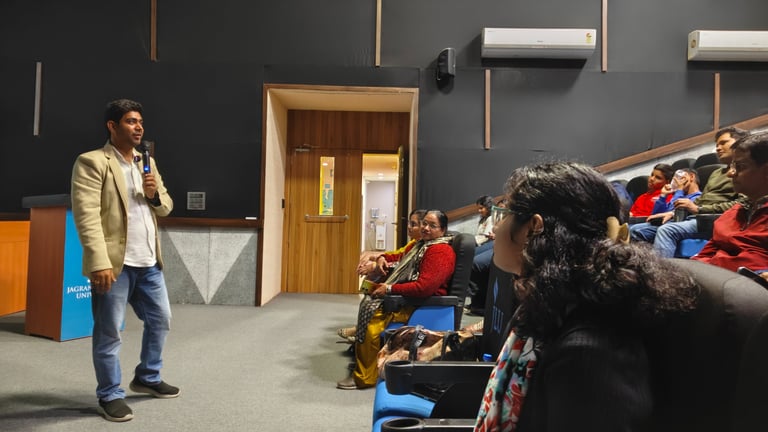
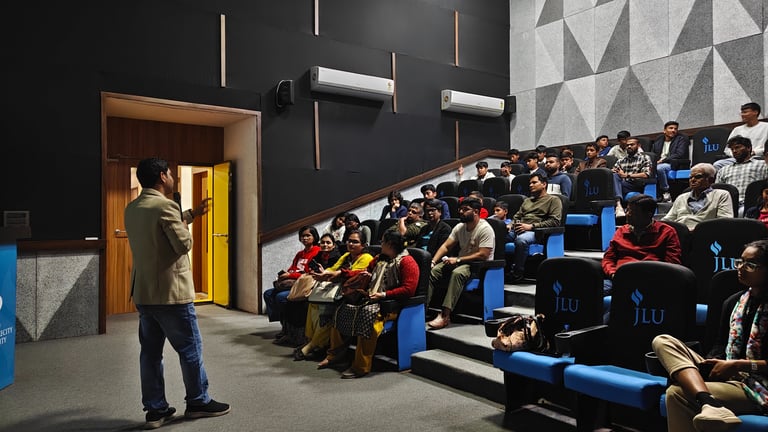
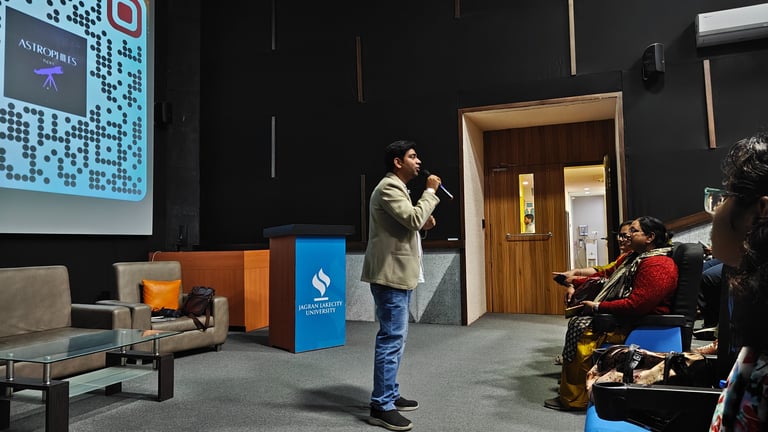
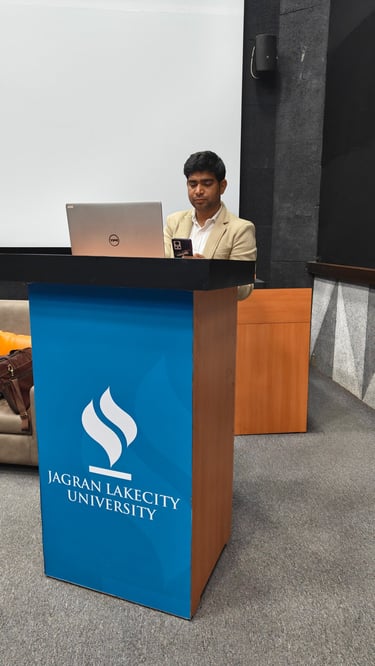
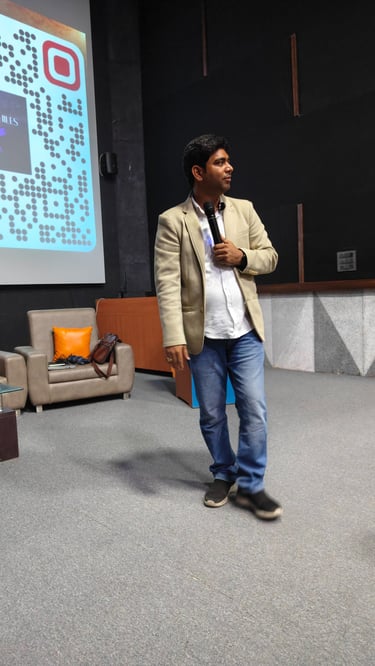
On January 17, 2026, the Bhopal Storytelling Fest transformed Jagran Lakecity University into a gateway to the stars. Amidst an atmosphere of intellectual curiosity, Sandeep Poddar of Astrophiles India presented "The Story of Time," a masterclass in cosmic perspective. Poddar’s mission was not merely to recount history, but to deconstruct the very fabric of our reality, challenging the audience to look beyond the ticking of clocks and perceive the vast, silent choreography of the universe.
The Philosophical Inquiry: What is Time?
The journey began not with equations, but with the haunting beauty of antiquity. Against backdrops of sun-drenched Greek columns and the stoic marble gaze of ancient philosophers, Poddar bridged the gap between human perception and physical truth. He presented a central, provocative thesis taken directly from the core of his inquiry: "Time is illusional, its nothing."
This segment explored the profound conceptual struggle that has plagued thinkers for millennia. We experience time as a relentless flow—a river carrying us from birth to death—yet Poddar suggested that this experience is a construct of our consciousness. To the universe, time may be something entirely different: a dimension we inhabit rather than a force that acts upon us.
The Scientific Reality: The Arrow and Relativity
Shifting from the abstract to the physical, the presentation delved into the mechanisms of the cosmos. Poddar utilized a striking visual of a woman in a rowing boat to explain the "Arrow of Time." The logic is as evocative as it is simple: like a rower, we look toward the "Past"—the wake behind the boat—seeing clearly where we have been, while being propelled into a "Future" that remains hidden behind our backs.
The talk then addressed the perennial question: Is Time Travel Possible? To answer, Poddar turned to Einsteinian physics. He presented the universe as a flexible fabric—space-time—illustrated by grid-like visuals where massive celestial bodies like the Sun and Earth create deep "gravity wells." Gravity is not merely a force pulling objects together; it is the warping of space-time itself. In the intense gravitational presence of a black hole, this warp becomes so extreme that time slows to a crawl, theoretically allowing for a leap across the cosmic calendar.
To bring these soaring concepts back to Earth, Poddar noted the practical necessity of technological synchronization. He highlighted the role of satellites and the evolution from analog to digital timekeeping, reminding the audience that our modern world depends on precisely aligning our human clocks with these cosmic rhythms.
Visual Synthesis of the Cosmos
The presentation was anchored by a recurring aesthetic of deep-space nebulae and starry "wells." Most striking was the "Spirit of the Universe"—a silhouette of a human figure in a meditative lotus pose. This figure was not a hollow shadow, but was filled with the vibrant watercolors of the cosmos. Within its chest burned a brilliant cyan and green nebula, a star-birthing region that transitioned into deep indigo and magenta limbs. This visual served as a silent testament to the "human-cosmos connection," illustrating that we are not merely observers of the universe, but the universe experiencing itself.
Sandeep Poddar concluded with a message of profound humility and adoration. The final slide, reading "Thank You, I Adore You!", served as an invitation for the audience to embrace their microscopic yet miraculous place in the 13.8-billion-year story. We are, as the visuals suggested, the dust of stars that has been given the briefest of seconds to look up and wonder.
As a committed science communcating unit, Astrophiles India will keep bringing you the stories and events that would leave you inspired and responsible for humanity and other creatures. If you want to want to know more about the events we organise, or want to book a show with us, simply click here or write to us as astrophilesindia@gmail.com.