
Half a Triumph at 322 Feet: Blue Origin Nails the Landing, Fumbles the Orbit
The NG-3 mission marked the first-ever reuse of a New Glenn booster — a genuine engineering milestone. But the satellite it was carrying ended up in the wrong orbit, and the customer had to write it off. The scorecard on Jeff Bezos's rocket is now complicated.
SPACE NEWS
Yashvardhan Joshi
4/23/20266 min read
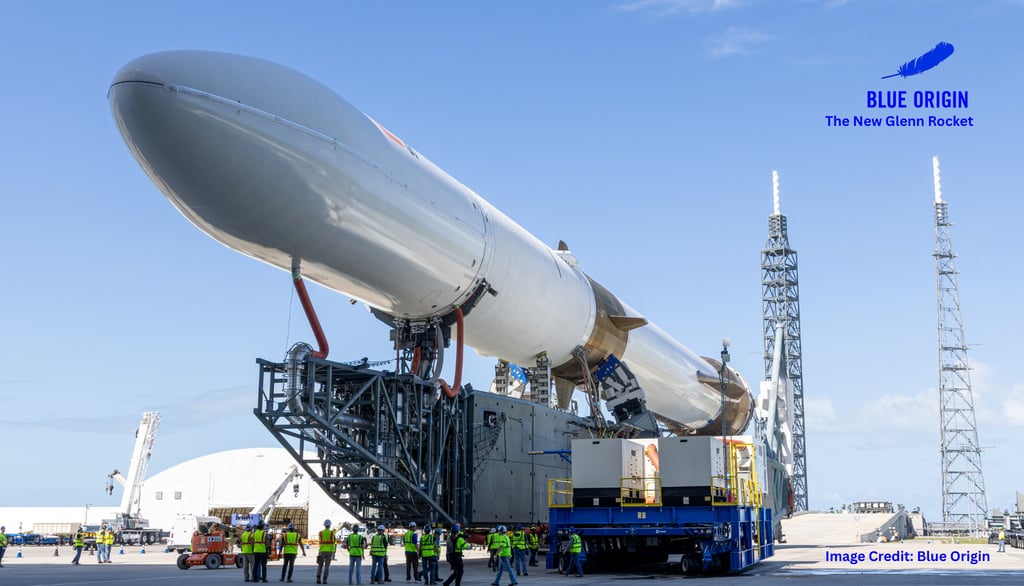
The NG-3 mission marked the first-ever reuse of a New Glenn booster — a genuine engineering milestone. But the satellite it was carrying ended up in the wrong orbit, and the customer had to write it off. The scorecard on Jeff Bezos's rocket is now complicated.
On the morning of April 19, 2026, at exactly 7:25 a.m. Eastern Time, a 322-foot rocket climbed off pad 36 at Cape Canaveral Space Force Station and punched through a clear Florida sky. About three minutes later, its first stage separated and began its long fall back toward the Atlantic. Ten minutes after liftoff, that booster — named, with characteristic Blue Origin bravado, "Never Tell Me the Odds" — touched down cleanly on the company's floating recovery ship, the Jacklyn, roughly 400 miles offshore.
The crowd watching from the launch site cheered. Engineers in the control room cheered. Blue Origin's CEO Dave Limp, who had spent the week talking up "unprecedented demand" for launches and promising 8 to 12 New Glenn missions in 2026, had plenty to celebrate. For a company that spent years watching SpaceX collect reusability milestones from the sidelines, this was real.
Then the second stage kept flying. And something, somewhere in the upper portion of that rocket, went wrong.
The Satellite That Didn't Make It
The payload on NG-3 was BlueBird 7, a six-ton satellite built by AST SpaceMobile — a Texas-based company trying to build a space-based cellular broadband network capable of connecting directly to ordinary smartphones, no special hardware required. BlueBird 7 was the second satellite in AST's next-generation Block 2 constellation, with a solar panel and antenna array spanning 2,400 square feet. It was meant to settle into a circular orbit 285 miles up, inclined at 49 degrees.
It did not. Blue Origin confirmed payload separation — the satellite physically detached from the rocket — and AST confirmed the satellite powered on. But roughly two hours after launch, Blue Origin disclosed that BlueBird 7 had ended up in an "off-nominal orbit," lower than planned. AST's statement was blunter: the satellite could not be raised to its intended altitude, and would have to be de-orbited. The cost of the satellite, the company noted, was expected to be covered by insurance.
AST SpaceMobile began 2026 with just seven satellites in orbit and has publicly committed to deploying 45 to 60 satellites by year-end. Losing one to an orbital miscue is a setback — though not a catastrophic one — in an aggressive build-out schedule. For Blue Origin, the implications are more pointed. It is one thing to lose a demonstration satellite. Delivering a paying customer's hardware to the wrong place raises questions about upper-stage reliability that the booster landing, however clean, cannot answer.
What Actually Got Reused (and What Didn't)
The booster that flew on Sunday — the same physical structure that launched NG-2 in November 2025, delivering NASA's twin ESCAPADE Mars probes — returned in one piece from that earlier mission and spent the intervening five months in Blue Origin's Florida facility being inspected and refurbished. Engineers replaced all seven BE-4 engines, keeping only the outer structure of the first stage. The BE-4 is a methane-fueled engine that Blue Origin also builds for United Launch Alliance's Vulcan rocket — and it is a complex piece of hardware. The decision to swap every engine rather than re-certify the flight-proven set suggests that, at this early stage of the program, Blue Origin found full replacement cheaper and safer than full inspection.
This is a telling detail. SpaceX's Falcon 9 now routinely reflies its Merlin engines without wholesale replacement — that routine is what makes the economics of reusability work. Blue Origin is not there yet. The company plans to reuse the NG-2 engines on a future mission once engineers have a better sense of what full reuse looks like in practice. Blue Origin also tested a new thermal protection system on one engine nozzle during NG-3, a change meant to better protect future first stages against the brutal heat of atmospheric reentry. Each New Glenn booster is designed to fly at least 25 times — that is the target — but the path from "flew twice" to "flew twenty-five times" runs through years of incremental refurbishment data.
Blue Origin also made guidance system upgrades to the booster for this flight, refining how the first stage re-enters the atmosphere and improving confidence in its onboard systems. The landing itself was precise, touching down on the Jacklyn roughly 400 miles offshore, consistent with the NG-2 recovery. None of that is trivial — sustaining a controlled vertical landing on a ship in the Atlantic, twice, with a rocket this size, is genuinely hard — but the engines being new softens the reusability claim somewhat. What flew on Sunday was a partially refurbished vehicle, not a fully turned-around one.
Three Flights, a Complicated Record
New Glenn's history is short and uneven. Flight one, in January 2025, successfully reached orbit — a significant achievement for a debut — but the first stage failed to land, lost somewhere over the Atlantic at roughly Mach 5.5 before the signal went dark. Flight two, in November 2025, sent NASA's ESCAPADE spacecraft on their trajectory toward Mars and successfully recovered the booster, making Blue Origin the second company ever, after SpaceX, to deploy a spacecraft in orbit while recovering the first stage. Flight three, on Sunday, nailed the booster recovery but missed the orbit. Blue Origin is now 1-for-3 on perfect missions, if by perfect you mean the payload ended up exactly where it was supposed to go.
That scorecard is not alarming in isolation — upper stage failures are not rare in the launch industry, and SpaceX's Falcon 9 has had its own second-stage anomalies over the years. What makes it complicated for Blue Origin is the context. The company had projected 6 to 8 New Glenn launches in 2025 and completed two. Now Limp is promising 8 to 12 in 2026, an aggressive ramp that depends on both manufacturing throughput and, crucially, customer confidence. A satellite ending up in the wrong orbit does not help with the latter.
What This Means for the SpaceX Competition
Before NG-3 launched, Micah Walter-Range of the space consultancy Caelus Partners wrote that a successful reuse would end SpaceX's nine-year run as the only player in reusable orbital rockets. That framing is now partially right. Blue Origin has proven it can recover a booster and fly it again. What it has not yet proven is that it can do so on a schedule and with a reliability that matters commercially.
New Glenn is a larger vehicle than Falcon 9 — 322 feet tall versus Falcon 9's 230 feet — and is aimed squarely at the heavy-lift market where SpaceX currently dominates with Falcon Heavy and hopes to eventually dominate with Starship. Like Starship, New Glenn uses a methalox propellant combination (liquid methane and liquid oxygen), which burns cleaner and is better suited for deep-space applications than Falcon 9's kerosene-based RP-1 fuel. Blue Origin is also building a lunar lander for NASA under the Artemis program, for which New Glenn will be the launch vehicle. The stakes are high, the contracts are real, and the pressure to demonstrate consistent upper-stage performance is only going to increase.
Blue Origin has announced plans to target a 30-day turnaround between New Glenn booster reuses. For comparison, SpaceX's fastest Falcon 9 turnarounds have come in under two weeks, though typical refurbishment takes longer. Getting to 30 days would be a genuine achievement — and a commercially meaningful one, since launch cadence directly determines how quickly a company can generate revenue and amortize development costs across missions.
Where Things Stand
Sunday's mission was, in a precise technical sense, a partial success. The booster came back. The satellite did not reach its destination. Both of those things are true, and the space industry will watch how Blue Origin responds — specifically, whether it can diagnose what went wrong in the upper stage quickly enough to maintain any semblance of its 2026 launch cadence.
The data from NG-3 — booster telemetry, upper stage logs, the behavior of the refurbished structure under load — will feed directly into the fourth flight's design. That is how rocket programs are built: not in leaps but in incrementally better decisions made possible by richer information. Blue Origin is a decade behind SpaceX in this process, but it is in the process now. The question, as it always is at this stage, is how fast the learning compounds.
For the moment, Blue Origin has achieved something real and something cautionary in the same morning. Whether Sunday gets remembered as the day the company turned a corner, or as one of the messier entries in a long development timeline, depends almost entirely on what comes next.
Astronomy has been a long-standing passion of mine — I follow space news regularly and have a particular love for observational astronomy and astrophotography. There's something about actually looking up, or capturing the sky through a lens, that keeps me grounded in why any of this matters.
-Yashvardhan Joshi, Young Astrophile